
Jawline tightening over 30 — filler, threads or laser?
The honest decision tree we use on Harley Street. Where most people waste money, what the face is actually doing in each decade, and why getting the order of treatments right matters more than the brand of any single product.
The quick answer
If you read nothing else, read this. Use the row that matches your decade — then read the section below it for the reasoning.
1. What actually happens to the jawline after 30
The face does not simply "drop" with age. It deflates, then descends. In your 20s, the mid-face — the fat compartments over your cheekbones and around your nose — is full, springy and well-supported by collagen-rich skin. That fullness is doing invisible architectural work: it holds the soft tissue of the lower face up. The moment that mid-face fullness begins to shrink (typically the early-to-mid 30s for most people, earlier for those with a slimmer facial type), gravity gets to work on tissue that was never designed to be self-supporting.
That is why the first sign of ageing on a 32-year-old jaw isn't usually the jaw at all. It is a faint shadow above the corner of the mouth — a half-millimetre of cheek tissue that has slipped a little lower than it used to sit. Left untreated for five years, that shadow deepens into a defined jowl. The skin overlying it stretches and loses elasticity. The fibrous septae — the tiny connective-tissue strings that anchor fat to bone — slacken. By 40, the problem is no longer "a little volume loss" — it is a structural, mechanical issue, and the treatments needed to reverse it are very different.
The principle: face loses volume → face sinks → face sags. Early volume replacement prevents sag. Once jowls are established, they're stubborn — and the only modalities that genuinely shift them are mechanical (PDO cog threads) or structural (Endolaser, surgery).
2. Why most people waste money on the wrong step
The two most common mistakes we see on consultations:
- Doing nothing until the jowl is obvious, then expecting a single syringe of filler to "lift" it. Filler does not lift heavy tissue; it volumises empty space. Putting it into a sagging jawline at 45 often makes the lower face heavier, not sharper.
- Starting with thread lifts at 33 because an Instagram clinic offered a "non-surgical facelift". At 33 there is usually nothing to lift. The threads dissolve in 9–14 months and you've paid £1,500 to solve a problem you didn't have.
The smart approach is to match the treatment to the cause at your specific stage — and to combine modalities only when the anatomy genuinely needs more than one.
3. Filler — the prevention tool (30–38)
When deployed in the early 30s, dermal filler is best understood as structural insurance. We are not chasing a look; we are restoring fullness to compartments that have started to deflate, so the lower face has no reason to descend.
For most patients in this window, the right answer is a small amount of filler in the mid-face (anterior cheek or zygomatic arch), sometimes paired with a touch in the chin to re-balance projection. Total volume is usually 1–2ml across the whole lower-third treatment plan, and the goal is that no one can tell you've had anything done.
When filler is the wrong tool: if you already have a defined jowl, visible nasolabial fold collapse and skin that no longer "snaps back" when pinched, filler alone will not fix it. You need a structural treatment first (Endolaser), and filler second, to refine the result.
Related reading: our dermal filler treatments, jawline filler, cheek filler.
4. PDO cog threads — the mechanical lift (35–48)
PDO (polydioxanone) cog threads are absorbable surgical sutures with tiny barbs ("cogs") along their length. When passed under the skin and gently retracted, the cogs grip the subcutaneous tissue and physically reposition it upward. Unlike smooth or mono threads — which work mainly through collagen stimulation — cog threads produce a same-day mechanical lift you can see in the mirror as you walk out of the clinic.
The honest version of the cog-thread conversation looks like this:
- Defined early-to-moderate jowl
- Visible nasolabial-to-jawline laxity
- Patients not ready for surgery
- Same-day visible repositioning
- A facelift substitute past 55
- Permanent — duration is 9–14 months
- A fix for pure volume loss
- Risk-free — bruising and palpable threads are common
We almost always combine PDO cogs with one or both of the other two modalities. Threads reposition the tissue; filler stabilises the new position; Endolaser tightens the skin envelope around it. Used alone, threads can look impressive at week one and disappointing by month nine. Used in combination, they buy you 18–24 months of meaningful improvement.
5. Endolaser — the structural fix (38–55+)
Endolaser is the treatment most people have not heard of and the one that, for the right patient, changes everything. A fibre thinner than a human hair is passed under the skin and delivers dual-wavelength laser energy (typically 1470nm + 980nm) directly into the deep dermis and superficial fat. Two things happen:
- The laser contracts the fibrous septae — the tiny tissue strings that have slackened and allowed the jowl to descend. That contraction is immediate and partly responsible for the early "tightening" effect.
- Over the following 3–6 months, the controlled thermal injury triggers new collagen production, progressively tightening the skin envelope from the inside.
Because the energy is delivered at the target depth rather than through the surface of the skin, Endolaser achieves more tightening per session than HIFU, radiofrequency microneedling or surface lasers — without leaving visible marks on the skin. Typical downtime is 3–7 days of mild swelling, occasionally a small bruise along one of the entry points.
This is the treatment behind our Endolaser Laser Fibre Lift. It is performed by our medical doctors on Harley Street and is the single most efficient treatment we offer for patients in their late 30s through 50s who want jawline definition without surgery.
6. The decision, in plain English
If you take one paragraph away from this article, take this one. In your early 30s, the right tool is small-volume filler in the mid-face to prevent the jowl ever forming. In your late 30s and early 40s, once a jowl shadow has formed, Endolaser is the highest-leverage single treatment — often combined with conservative filler. In your mid-40s onward, when there is mechanical laxity, PDO cog threads earn their place alongside Endolaser. Past the mid-50s, if the laxity is severe, an honest surgeon's conversation about a deep-plane facelift is the kind thing to have — non-surgical can only do so much, and pretending otherwise wastes your money.
7. What to ask in a consultation
- Will a GMC-registered doctor perform the treatment, or a non-medical practitioner?
- If you're recommending filler, why filler and not a structural treatment?
- If you're recommending threads, what's the combination plan for after they dissolve?
- If you're recommending Endolaser, is the device dual-wavelength and UKCA/CE-marked?
- What is the management plan if I bruise, get a small burn or develop an infection?
- What does success look like at 3, 6 and 12 months — not just at week one?
8. The Cosmedocs approach
Our aesthetics is invisible art — bold, natural, always your way. We do not sell single treatments; we plan jawlines. A first consultation maps your specific anatomy, identifies which decade of change you're in, and matches the smallest possible intervention to the largest possible result. Sometimes that's a single syringe of filler. Sometimes it's one Endolaser session. Occasionally it's all three modalities, sequenced over six months. Whatever it is, you will leave the consultation knowing exactly why.
The first phase: volume loss, before sag sets in
The over-30 face does not sag first — it sinks first. Mid-face fat pads deflate, the cheek loses projection, and the skin envelope that used to sit over a fuller scaffold starts to drift downward. Caught at this phase, a small, precisely-placed volume restoration arrests the descent and keeps the jawline crisp — no threads, no laser, no downtime. Below are two real Cosmedocs patients photographed at this exact stage.
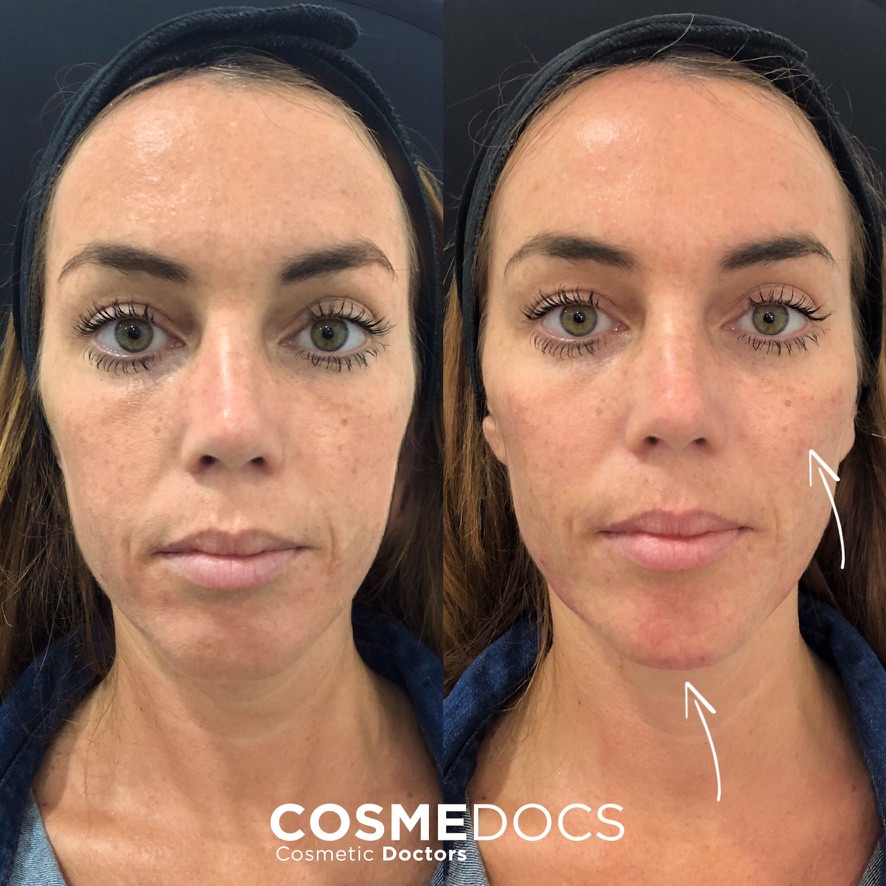
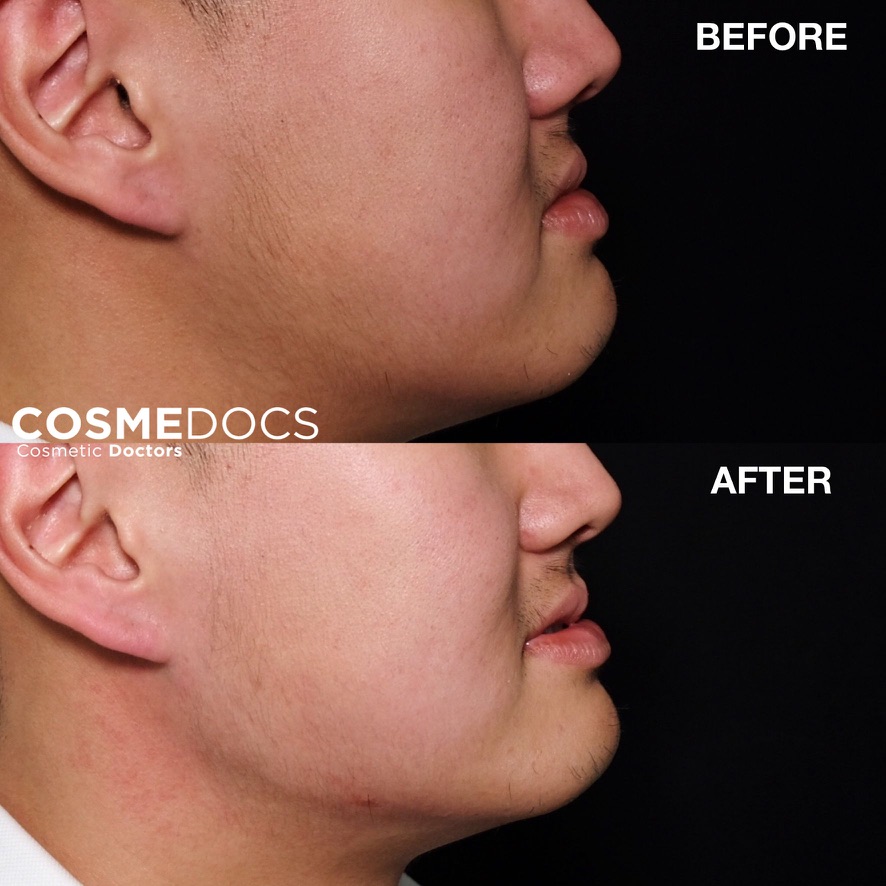
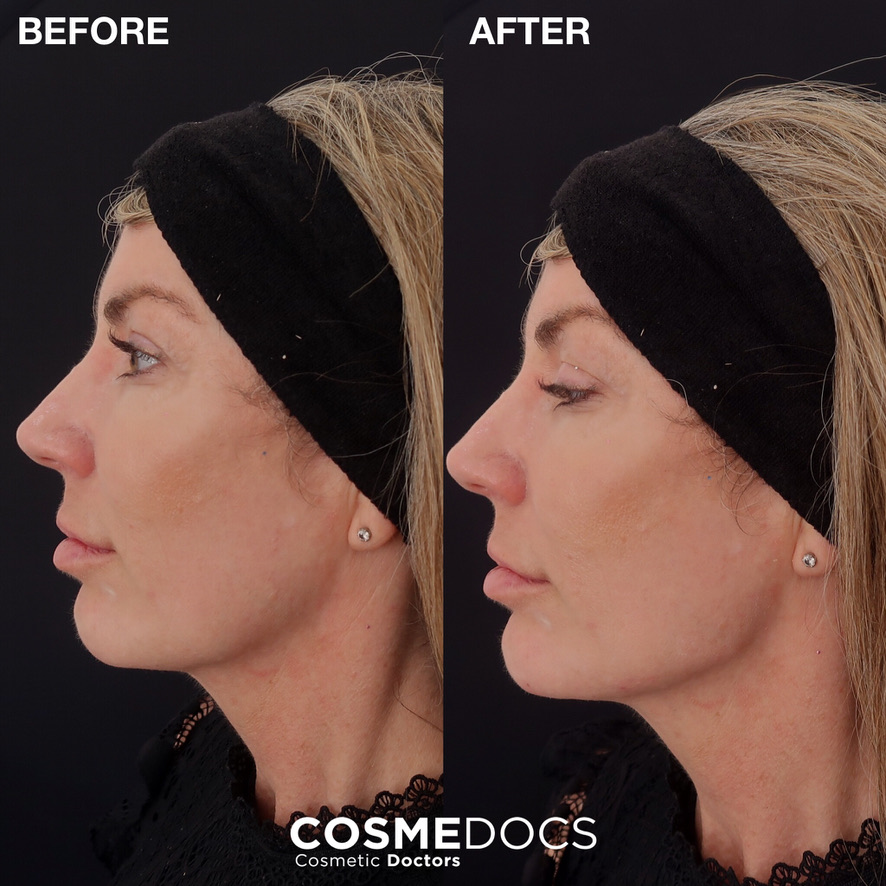
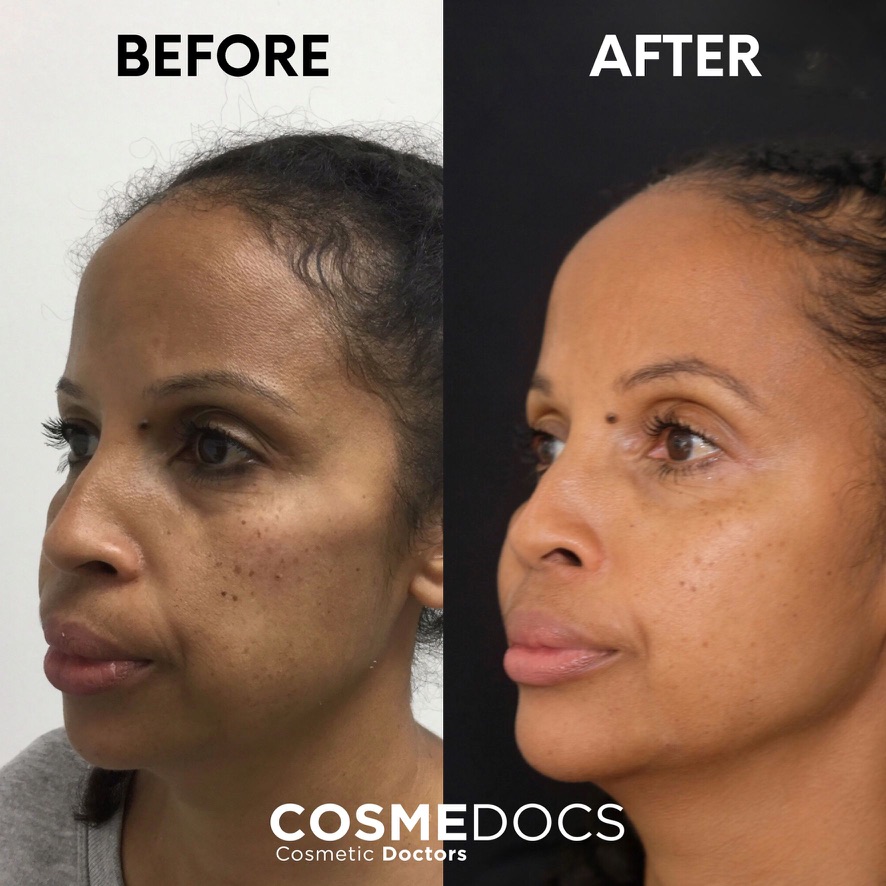
Real Cosmedocs patients, photographed with consent under standardised lighting. Individual results vary. Photographs are clinical records, not retouched marketing imagery. See more outcomes on our dermal filler before & after gallery or read the jawline filler treatment page.
Endolaser Jawline Tightening
Dual-wavelength Endolaser performed by our medical team on Harley Street. The structural fix for established jowls and jawline laxity — more tightening per session than HIFU or radiofrequency, with 3–7 days downtime.
Common questions
I'm 32 and my jaw is still sharp — am I too early for any of this?+
No — early-30s is the most strategic window. A small volume restoration in the mid-face now (1ml or less) can prevent the jowl that would otherwise need cog threads or laser in your 40s. Prevention is cheaper, less invasive and more natural-looking than correction.
Will filler give me a sharper jawline or make it heavier?+
Done correctly, mid-face and chin filler lift the lower face without adding bulk to it. Heavy-looking jawlines usually come from injecting filler directly into the masseter region without addressing the deflated mid-face that caused the descent in the first place.
How is Endolaser different to HIFU or radiofrequency microneedling?+
HIFU and RF microneedling deliver energy through the skin — every photon spends part of itself heating tissue you didn't want heated. Endolaser passes a hair-thin fibre under the skin and delivers laser energy at the exact depth of the fibrous septae anchoring the jowl. The result is more tightening per session, with the same downtime.
Do PDO cog threads really lift, or is it marketing?+
Cog threads lift mechanically on day one — that part is real. What's oversold is duration. Honest results last 9–14 months on average. Threads work best as part of a combination plan (often with filler or Endolaser), not as a standalone facelift substitute.
How much downtime should I expect?+
Filler — 24–72 hours of mild swelling, occasional bruising. PDO cogs — 5–10 days of tightness and possible bruising at insertion points. Endolaser — 3–7 days of mild swelling, sometimes light bruising along the treated lines. None require time off work for most patients.
How much does Endolaser for the jawline cost?+
Pricing depends on the area treated and whether it is combined with other modalities. A typical single-area Endolaser session for jawline tightening starts from £950, performed by our medical doctors on Harley Street. Every treatment includes consultation, the procedure itself, and a review. An exact quote is given after your clinical assessment.