CosmeTalk / Workplace health
Is your laptop giving you jaw pain, neck pain and headaches?
How we built a working life around a screen, forgot to move, started clenching our teeth — and then wondered why everything hurts.
· 15 min read
The short answer
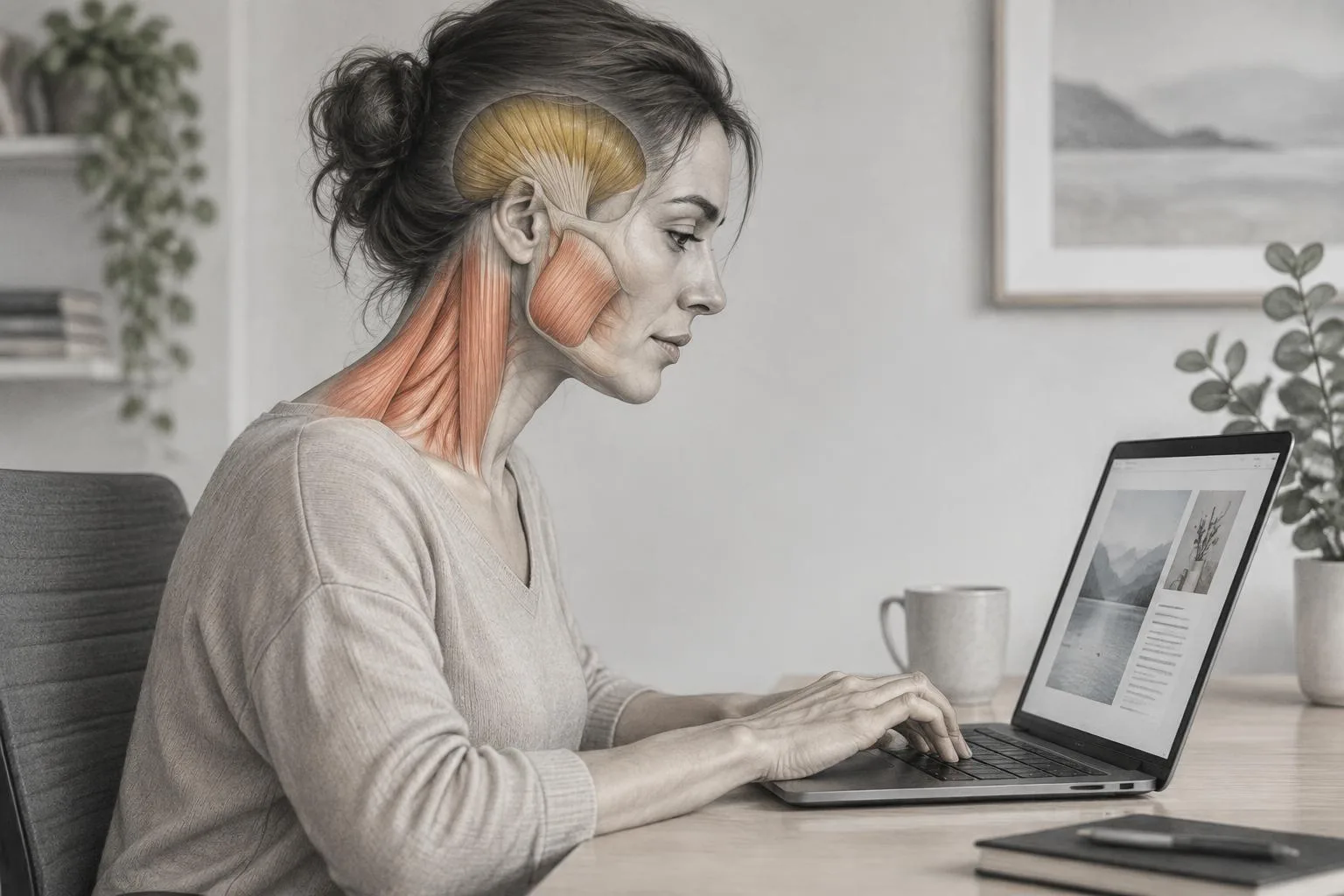
Long screen sessions can coincide with neck loading, less movement, stress and unnoticed jaw clenching. Published research supports associations, not a single proven laptop-to-headache cause. Start with movement, habit awareness and appropriate assessment — not an assumption that an injection fixes the whole loop.
Why I started asking about screens
There is a certain type of patient I seem to see all the time now.
They walk in rubbing their jaw.
Or their neck.
Or their temples.
Sometimes all three, because apparently modern life likes a package deal.
One has been told they grind their teeth. Another swears they don't grind anything. Their dentist has made them a mouthguard. Their physio has worked on their neck. They have changed pillows three times, bought something ergonomic from Amazon and briefly considered yoga.
Yet the jaw still aches.
The neck is still tight.
The headache keeps coming back.
So eventually I ask the question nobody seems particularly interested in.
How many hours a day do you spend looking at a computer?
Six.
Eight.
Ten.
Laptop?
Usually.
Stressful?
Please.
It's 2026.
Of course it is.
And after hearing versions of this story repeatedly, we decided to look at our own patients.
In our most recent group of 215 clients presenting with bruxism, neck pain or headaches — excluding migraine — more than 70% reported using a computer or laptop for more than six hours every day.
Now, before somebody writes an angry email, this does not prove that laptops cause neck pain, bruxism or headaches.
Science is inconvenient like that.
Seeing two things together doesn't automatically mean one caused the other.
But it was enough to make me curious.
Because when we started looking at the published research, something rather interesting happened.
Six hours kept turning up.
Six hours seems to be where things get interesting
One study involving 740 office workers looked at computer use and neck pain.
People spending more than six hours per working day on a computer had significantly greater odds of neck pain — approximately 61% higher odds in the study’s adjusted analysis.
Psychological distress mattered too.
Which sounds remarkably similar to half the people currently replying to emails at 11.43 pm with their shoulders somewhere near their ears.
Then came a larger 2025 systematic review and meta-analysis.
Twenty-five studies.
More than 43,000 people.
The researchers found an association between sedentary behaviour and neck pain, and the longer people were sedentary, the stronger the association became.
In the subgroup reporting six hours or more of sedentary time per day, the odds ratio was 1.88 (95% confidence interval 1.42–2.48). Sedentary time is not the same measurement as laptop use. This is an association, not an 88% increase in an individual’s absolute risk, and not a proven six-hour safety limit.
Computer use itself was associated with neck pain as well.
None of this means that six hours and one minute on a MacBook suddenly destroys your cervical spine.
Bodies aren't parking meters.
But when our own patients reported prolonged computer use alongside symptoms, I stopped thinking of it as an entirely boring coincidence.
There may be something here.
Just probably not the thing everyone thinks.
No, your posture isn't evil
We've become rather hysterical about posture.
Sit straight.
Shoulders back.
Chin tucked.
Feet flat.
Monitor exactly seventeen degrees below whatever somebody on TikTok decided your eye line should be.
Basically, spend your working life pretending to be a Victorian child having a photograph taken.
I don't think that's the answer.
There probably isn't one magical posture that protects the human body from pain.
Your body was built to move.
Your head moves.
Your shoulders move.
Your neck rotates.
Your jaw opens and closes.
You lean.
You straighten.
You wander around.
You scratch something.
You look out the window.
You get up because you remembered you left your coffee somewhere.
Normal human behaviour involves endless small changes in position.
And then somebody invented Microsoft Teams.
Suddenly you can spend three hours barely moving anything below the eyes.
That is probably more interesting than obsessing over whether your neck is sitting at precisely the correct angle.
The issue may not simply be bad posture.
It may be:
one posture + too much time.
The laptop is an ergonomic practical joke
I love laptops.
We all love laptops.
They let you run a company from a café, write a dissertation from bed and pretend to work while watching Netflix in another tab.
But ergonomically they have one small design problem.
The keyboard is attached to the screen.
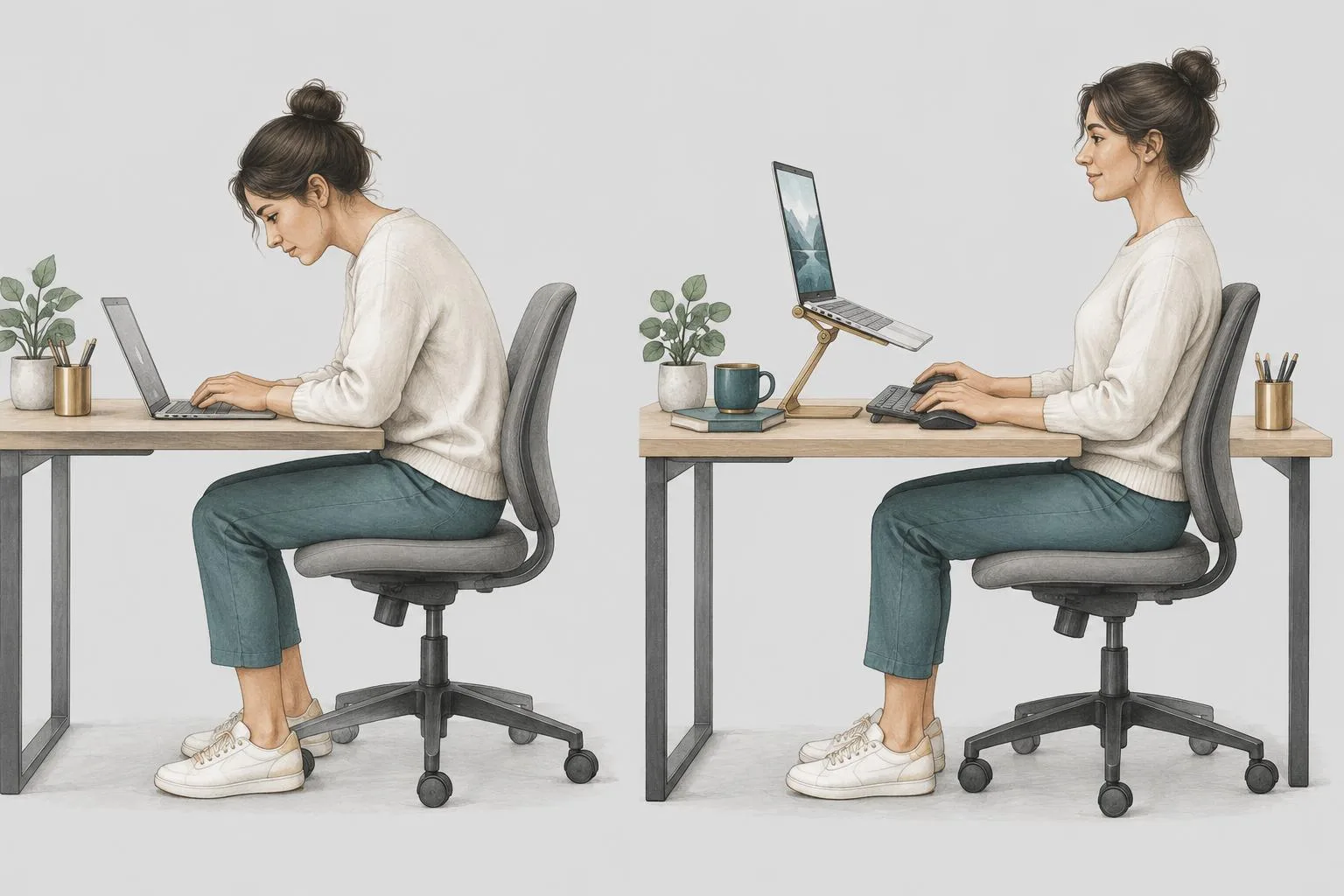
If the keyboard is at the right height for your hands, the screen is often too low for your head.
If you lift the screen to eye level, your arms suddenly need to belong to an orangutan.
Desktop computers don't have this problem because you can position the monitor and keyboard independently.
In a laboratory study comparing devices, Yu and colleagues found roughly 11 degrees more neck flexion with a laptop than a seated desktop setup. It measured positioning during tasks, not whether that angle caused long-term pain. A separate keyboard and mouse let you adjust the screen and your hands independently.
Eleven degrees doesn't sound dramatic.
But an angle alone does not establish harm.
Time changes things.
Hold something for long enough and biology begins to care.
And that's before you include the wonderfully ergonomic practice of working on a laptop from a sofa while your spine slowly takes the shape of a question mark.
And while all this is happening, your jaw has joined the meeting
This is the part I find particularly interesting.
Mention bruxism and most people imagine someone asleep at night grinding their teeth together like they're trying to produce flour.
Sometimes that happens.
But bruxism is more complicated than that.
There is also awake bruxism.
Clenching.
Teeth touching unnecessarily.
Holding the jaw tense.
Bracing the mandible.
Basically using the chewing muscles when there isn't anything to chew.
And you may have absolutely no idea you're doing it.
Nobody hears anything.
Your partner doesn't complain.
Your teeth haven't turned into tiny white stumps.
Yet your masseter and temporalis muscles may spend half the working day performing unpaid overtime.
I see patients with sore, bulky masseters who tell me:
“But I don't grind.”
Maybe not.
Some people grind.
Some people clench.
Some people simply hold.
And a surprising number of people seem to concentrate with their jaw.
Watch yourself tomorrow.
Not now.
Tomorrow, when somebody sends you an irritating email.
See what your teeth are doing.
Stress: because apparently the laptop wasn't enough
Now let's add stress.
A 2020 systematic review by Chemelo and colleagues found an association between stress and bruxism: approximately twice the odds (OR 2.07; 95% confidence interval 1.51–2.83). The authors rated the certainty of evidence as low. It does not tell us whether stress is the cause, or whether every person under stress will clench.
The quality of that evidence isn't perfect.
Few things involving human behaviour are.
But clinically it makes sense.
Stress does strange things to muscles.
You don't have to be having a nervous breakdown.
You can simply be running late.
Working to a deadline.
Waiting for somebody to reply.
Trying to fix something at 4.55 pm on Friday.
The shoulders creep upwards.
The breathing changes.
The jaw tightens.
The forehead joins in because apparently everybody wants a job.
Stress doesn't necessarily create the entire problem.
It may simply turn the volume up.
Imagine two people using exactly the same laptop.
One works for two hours, gets up, wanders around, has lunch, laughs, goes outside and comes back.
The other works nine hours, has four coffees, ignores lunch, sleeps badly and spends most of the afternoon wondering why Karen still hasn't sent the spreadsheet.
Technically:
same computer.
Biologically:
not remotely the same day.
The jaw and the neck know each other
Medicine loves departments.
It's comforting.
Jaw?
Dentist.
Neck?
Physiotherapist.
Headache?
Neurologist.
Excellent.
Three departments.
Four appointments.
Possibly a scan.
Everyone gets a letter.
Unfortunately, your nervous system has not agreed to this administrative arrangement.
The jaw and neck are closely related functionally and neurologically.
Studies looking at people with temporomandibular disorders — TMD — repeatedly find more cervical problems as well.
Reduced neck mobility.
Greater neck disability.
Less endurance in some cervical muscles.
Interestingly, researchers haven't consistently found that these patients simply have visibly “bad posture”.
That matters.
You can have genuine cervical and jaw dysfunction without looking like Quasimodo at your desk.
The problem can be subtler.
Function.
Load.
Muscle behaviour.
Pain processing.
Time.
A 2020 systematic review by Cuenca-Martínez and colleagues found an association between neck disability and jaw disability in patients with TMD, alongside differences in cervical function. Evidence for a consistent difference in visible alignment was less clear.
Again, that does not tell us which came first.
Maybe the neck affects the jaw.
Maybe the jaw affects the neck.
Maybe something else affects both.
Perhaps trying to make every chronic pain problem into a single straight arrow is part of the problem.
Bodies prefer circles.
Then comes the headache
Which brings us neatly to the head.
Not every headache is caused by muscles.
That needs saying clearly.
Migraine is a different animal.
New headaches, severe headaches, neurological symptoms and unusual headache patterns need appropriate medical assessment.
Please don't read a blog on the internet and diagnose yourself with Laptop Head.
We specifically excluded migraine presentations from our little clinical observation because we were interested in another group.
Tension-type headaches.
Cervicogenic headaches.
Patients with sore temples, tight necks, painful jaws and symptoms that seemed to live somewhere around the intersection of all three.
And research suggests that intersection is real.
Tension-type headache populations commonly demonstrate cervical and pericranial muscular abnormalities.
TMD and headache frequently coexist.
Neck pain and TMD frequently coexist.
Which leaves us with a fairly interesting triangle:
JAW
NECK
HEAD
And sitting quietly beside it is a laptop that nobody has switched off since breakfast.
The Screen–Stress–Jaw–Neck Loop
So this is the clinical model I've started thinking about.
Not:
LAPTOP → HEADACHE
That's children's television science.
Instead:
LONG SCREEN EXPOSURE
↓
REDUCED MOVEMENT + SUSTAINED CERVICAL LOAD
plus
CONCENTRATION + PSYCHOLOGICAL STRESS
↓
JAW BRACING / CLENCHING / INCREASED MUSCLE ACTIVITY
↓
MASSETER + TEMPORALIS + CERVICAL MUSCLE OVERLOAD
↓
JAW PAIN / NECK PAIN / TENSION-TYPE OR CERVICOGENIC HEADACHE
And then pain itself makes you tense.
Which makes you clench.
Which makes you hurt.
Congratulations.
You have invented a loop.
I call it the screen–stress–jaw–neck loop.
It's a proposed clinical model, not a proven disease or a diagnosis. The arrows describe possible interactions, not an established causal chain.
But increasingly I think it's worth investigating.
Your job title may be completely irrelevant
Another thing became obvious looking at our patients.
They weren't all bankers.
Or programmers.
Or lawyers.
There wasn't one magical profession getting jaw pain.
Doctors do it.
Students do it.
Business owners do it.
Designers do it.
Accountants do it.
People supposedly “working from home” do it while sitting at a kitchen table surrounded by increasingly cold cups of coffee.
Which makes me wonder whether one of our standard consultation questions is becoming outdated.
We ask:
“What do you do for work?”
Fine.
But perhaps the better question is:
“What does your body actually do while you're working?”
Because occupational titles tell us remarkably little about physical exposure anymore.
A cardiologist, architect and marketing executive may have absolutely nothing professionally in common.
Their necks, however, may all spend eight hours looking approximately twenty degrees downward at exactly the same glowing rectangle.
The cervical spine doesn't particularly care what degree you have.
Bruxism isn't always a dental problem
To be precise, bruxism and TMD are not the same thing.
Bruxism describes jaw-muscle activity and behaviours including clenching and grinding.
TMD describes disorders involving the temporomandibular joint, chewing muscles and related structures.
They overlap.
But they're not interchangeable.
Research has found an association between bruxism and TMD, particularly awake bruxism.
Which is why asking only:
“Do you grind your teeth at night?”
may be missing half the story.
When somebody sits in front of me with large painful masseters, I also want to know what's happening at:
3.17 pm on Tuesday.
They're not asleep.
They're not chewing.
They're staring at Excel.
So why are their masseters working?
That, to me, is the interesting question.
What are you supposed to do? Quit your job?
No.
Although depending on your boss, I don't want to completely rule it out.
The solution is probably not to throw your MacBook into the Thames and disappear to a monastery.
We still have to work.
We just need to make working slightly less physiologically ridiculous.
Raise the laptop where practical.
Use a separate keyboard and mouse.
Change position frequently.
Don't spend eight hours searching for one perfect sitting posture.
There isn't one.
Move.
Stand occasionally.
Walk.
Look somewhere further away than fourteen inches from your nose.
Let your shoulders relax.
And perhaps most importantly:
check your jaw.
When you're not chewing or swallowing, your teeth don't need to spend the entire day passionately embracing each other.
Notice whether you're holding tension there.
Clenching.
Bracing.
Pressing.
Some patients are surprised when I ask them to pay attention.
Then they return a few weeks later and say:
“I had no idea how much I was doing it.”
Exactly.
Exercise probably matters more than another ergonomic gadget
There is reasonable evidence that appropriate exercise and strengthening programmes can reduce neck pain and disability in office workers.
Which is encouraging because the alternative offered by the internet usually involves purchasing an £89 memory-foam object.
Strength.
Movement.
Variation.
Breaks.
Sleep.
Stress management.
Not particularly sexy.
Unfortunately, biology has never been especially interested in marketing.
You don't necessarily need the perfect chair.
You may need to get out of the chair.
And where does Botox fit into all of this?
Eventually, somebody asks.
Because botulinum toxin can reduce masseter muscle activity, and we use it in selected patients with significant masseter hypertrophy, jaw-muscle hyperactivity and bruxism-related symptoms.
Any possible benefit needs to be weighed against the uncertainty in the evidence and the risks for that individual.
But here's where aesthetic medicine occasionally gets itself into trouble.
It sees a large muscle and thinks:
inject muscle.
Problem solved.
Not always.
If somebody spends ten hours every day tensing their jaw because they're stressed, sedentary and welded to a laptop, weakening the masseter may improve one part of the problem.
It doesn't magically reorganise their life.
The consultation therefore matters more than the syringe.
Botulinum toxin for bruxism or muscular TMD is an off-label use in the UK. It is not a routine first-line answer to jaw pain. Conservative care, dental assessment and rehabilitation usually come first. Potential risks include chewing weakness, asymmetry and muscle atrophy; concerns about effects on bone need discussion, particularly with repeated treatment.
Which is exactly how it should be.
Sometimes the muscle needs treating.
Sometimes the behaviour needs changing.
Sometimes the workstation needs changing.
Sometimes the neck needs rehabilitation.
Sometimes the patient needs to sleep.
And sometimes all of the above would be nice.
Medicine tends to become less exciting but considerably more useful when we stop pretending one intervention fixes everything.
So what did our 215 patients actually tell us?
This needs to be stated carefully.
We saw 215 consecutive patients presenting with bruxism, neck pain or non-migraine headache.
More than 70% reported computer or laptop use for over six hours each day.
That's interesting.
It is not proof of causation.
We don't yet have an asymptomatic control group.
We haven't proved that the laptop produced their symptoms.
It may even turn out that six-hour computer use is simply very common in the population we treat.
That is why the next stage matters.
We need to compare symptomatic patients with people without these problems.
Measure screen time properly.
Separate desktop from laptop use.
Look at stress.
Sleep.
Exercise.
Awake clenching.
Break frequency.
Maybe even posture, although hopefully without turning everybody into frightened statues.
And then ask whether that six-hour signal remains.
If it does, things get much more interesting.
When should you actually see somebody?
Aching muscles after a brutal week in front of a screen are one thing.
Persistent symptoms are another.
Get properly assessed if you have ongoing jaw pain, significant restriction in mouth opening, locking, problematic clicking, dental damage, persistent facial pain, recurring neck pain or frequent headaches.
And if you develop a sudden severe or unusual headache, neurological symptoms, visual changes, fever, significant trauma or anything else concerning, don't assume it's because you've been hunched over PowerPoint.
That's what proper medical assessment is for.
The point of recognising this jaw–neck relationship is not to explain every pain symptom with one trendy diagnosis.
It's the opposite.
It's to look at the whole patient before deciding which bit deserves treatment.
We weren't designed around a rectangle
Human beings have been around for quite a while.
The laptop has not.
Yet within a remarkably short period of history, we've redesigned adult life around staring at illuminated rectangles.
We work on them.
Shop on them.
Argue on them.
Date on them.
Watch television on them.
And when we've finally finished eight hours on the big rectangle, we lie in bed and celebrate by staring at the little rectangle.
Then we wonder why our neck feels stiff.
There is still a lot we don't know.
The evidence does not justify saying that computers directly cause bruxism, neck pain or headaches in everyone.
Pain is complicated.
Anatomy matters.
Injury matters.
Sleep matters.
Exercise matters.
Psychology matters.
Stress matters.
Individual susceptibility matters.
But we can reasonably say that prolonged computer exposure is associated with neck pain.
In laboratory tasks, laptop and desktop setups have produced different neck positions; this does not by itself establish injury.
Stress is associated with bruxism.
Jaw disorders and neck disorders frequently coexist.
And jaw, neck and headache symptoms overlap far more than the neat little boxes of traditional medicine sometimes suggest.
Then we have our own observation:
more than seven out of ten of 215 patients presenting with bruxism, neck pain or non-migraine headache were using computers for more than six hours a day.
That doesn't prove anything yet.
But it's enough to make me want to look harder.
Because perhaps we've been asking the wrong question.
We ask the patient with the painful jaw:
“Do you grind your teeth at night?”
Fair enough.
But maybe the better question is:
“What are your jaw and neck doing for the other sixteen hours?”
Because that may turn out to be where the real story is.
Do not put every headache down to a screen
Call 999 for a sudden extremely severe headache, or headache with new weakness, difficulty speaking, loss of vision, confusion or a seizure. Fever with a stiff neck also needs urgent help. New temple pain with jaw pain on chewing — particularly over age 50 — requires urgent assessment. For persistent or uncertain symptoms, speak to your GP or dentist; NHS 111 can advise on urgency.
Questions people ask
Can laptop use cause jaw pain and headaches?
Prolonged screen work can coincide with sustained neck loading, stress and awake jaw clenching. Research supports associations between sedentary behaviour and neck pain, and between jaw and neck disorders, but does not prove that a laptop directly causes every symptom. Persistent pain needs assessment.
Why do I clench my jaw while working at a computer?
Concentration and stress can accompany awake bruxism: clenching, jaw bracing or holding the chewing muscles tense. It can happen without audible grinding or awareness. Notice the habit without repeatedly testing or tightening your jaw, and seek dental advice if you have pain or tooth damage.
Is six hours of screen time a medical danger threshold?
No. Six hours is a category used in some observational research, not a proven cut-off. Sedentary time and computer time are different exposures. Odds ratios describe associations in groups, not your personal risk or proof of causation.
Can jaw problems and neck pain be connected?
Temporomandibular disorders and neck symptoms commonly coexist. Shared muscle function, pain processing and other factors may contribute. Coexistence does not establish which came first, and each symptom still needs an appropriate assessment.
What can I change at my desk?
Try a comfortable screen height, a separate keyboard and mouse where practical, regular changes of position and breaks from sitting. Avoid searching for one perfect posture. Tailored exercise or physiotherapy may help persistent neck symptoms; dental assessment may be needed for jaw pain.
Is botulinum toxin the first treatment for laptop-related jaw pain?
No. It is not a routine first-line treatment for jaw pain, and use for bruxism or muscular TMD is off-label in the UK. Dental assessment, education, habit awareness and appropriate rehabilitation come first. Any later treatment requires an individual discussion of evidence, alternatives and risks.
When should a headache or jaw pain be assessed urgently?
Call 999 for a sudden extremely severe headache or a headache with new weakness, speech difficulty, loss of vision, confusion or seizure. Fever with a stiff neck also needs urgent help. New temple pain with jaw pain on chewing, especially over age 50, requires urgent assessment. Persistent jaw locking, restricted opening, tooth damage or recurring pain should be assessed rather than blamed on a screen.
Research and sources
Published sources are separate from the author’s unpublished clinic figures. Observational evidence cannot establish causality.
- Chen X, O’Leary S, Johnston V. Modifiable individual and work-related factors associated with neck pain in 740 office workers: a cross-sectional study. Brazilian Journal of Physical Therapy. 2018;22(4):318–327. PMID: 29606511.
- Meng Y and colleagues. The associations between sedentary behavior and neck pain: a systematic review and meta-analysis. BMC Public Health. 2025;25:453. DOI: 10.1186/s12889-025-21685-9. Includes 25 studies and 43,184 participants; substantial heterogeneity limits interpretation.
- Yu Z, James C, Edwards S, Snodgrass SJ. Differences in posture kinematics between using a tablet, a laptop, and a desktop computer in sitting and in standing. Work. 2018;61(2):257–266. DOI: 10.3233/WOR-182796. Positioning differences are not proof of injury.
- Chemelo VS and colleagues. Is There Association Between Stress and Bruxism? A Systematic Review and Meta-Analysis. Frontiers in Neurology. 2020;11:590779. DOI: 10.3389/fneur.2020.590779. Low-certainty evidence.
- Cuenca-Martínez F and colleagues. Craniocervical and Cervical Spine Features of Patients with Temporomandibular Disorders: A Systematic Review and Meta-Analysis of Observational Studies. Journal of Clinical Medicine. 2020;9(9):2806. DOI: 10.3390/jcm9092806.
- Louw S and colleagues. Effectiveness of exercise in office workers with neck pain: A systematic review and meta-analysis. South African Journal of Physiotherapy. 2017;73(1):392. DOI: 10.4102/sajp.v73i1.392.
- Royal College of Surgeons of England / Faculty of Dental Surgery. Management of painful temporomandibular disorder in adults. Clinical guidance supporting assessment and conservative management.
Assessment before intervention
For the clinical pathways, read our jaw, headache and neck pain assessment guide. Where appropriate, assessment may include the masseter muscles — but that does not make an injection the starting point.
Diagnosis before intervention.
Our aesthetics is invisible art. Bold • Natural • Always Your Way.
Educational information, not a diagnosis or personalised treatment advice. We work with PrivaDr Ltd, 10 Harley Street, London W1G 9PF for all CQC required treatments.