Disclosure: Cosmedocs provides Endolaser, not XERF or branded Endolift. This is a comparison of published sources and treatment principles, not an independent trial or a claim of superiority.
What is XERF — and is it simply radiofrequency renamed?
XERF is a Cynosure Lutronic platform developed in South Korea. It belongs to the non-invasive monopolar radiofrequency family. The manufacturer's phrase ‘structural skin tightening’ describes its intended effect; it is not a new form of energy. Radiofrequency produces tissue heating through the interaction of an alternating electrical field with tissue. That principle has been used in aesthetic medicine for years.
Calling it just an old machine with a new name would nevertheless miss a technical difference. XERF sequentially delivers 6.78 MHz and 2 MHz within a single pulse, with adjustable treatment settings, impedance monitoring and surface cooling. The device-specific claim is a different delivery system, not the invention of radiofrequency. Whether those refinements produce a clinically important advantage over established RF requires comparative evidence, not a new marketing vocabulary.
MHz is a measure of radiofrequency; nm is a laser wavelength. You cannot compare 2 MHz with 1470 nm and declare one ‘stronger’. They describe different physical quantities. Tissue exposure also depends on dose, duration, electrode geometry, cooling, tissue properties and technique. A specification sheet is not a league table of lifting power. [1,2]
Above the skin or below the skin? The important distinction
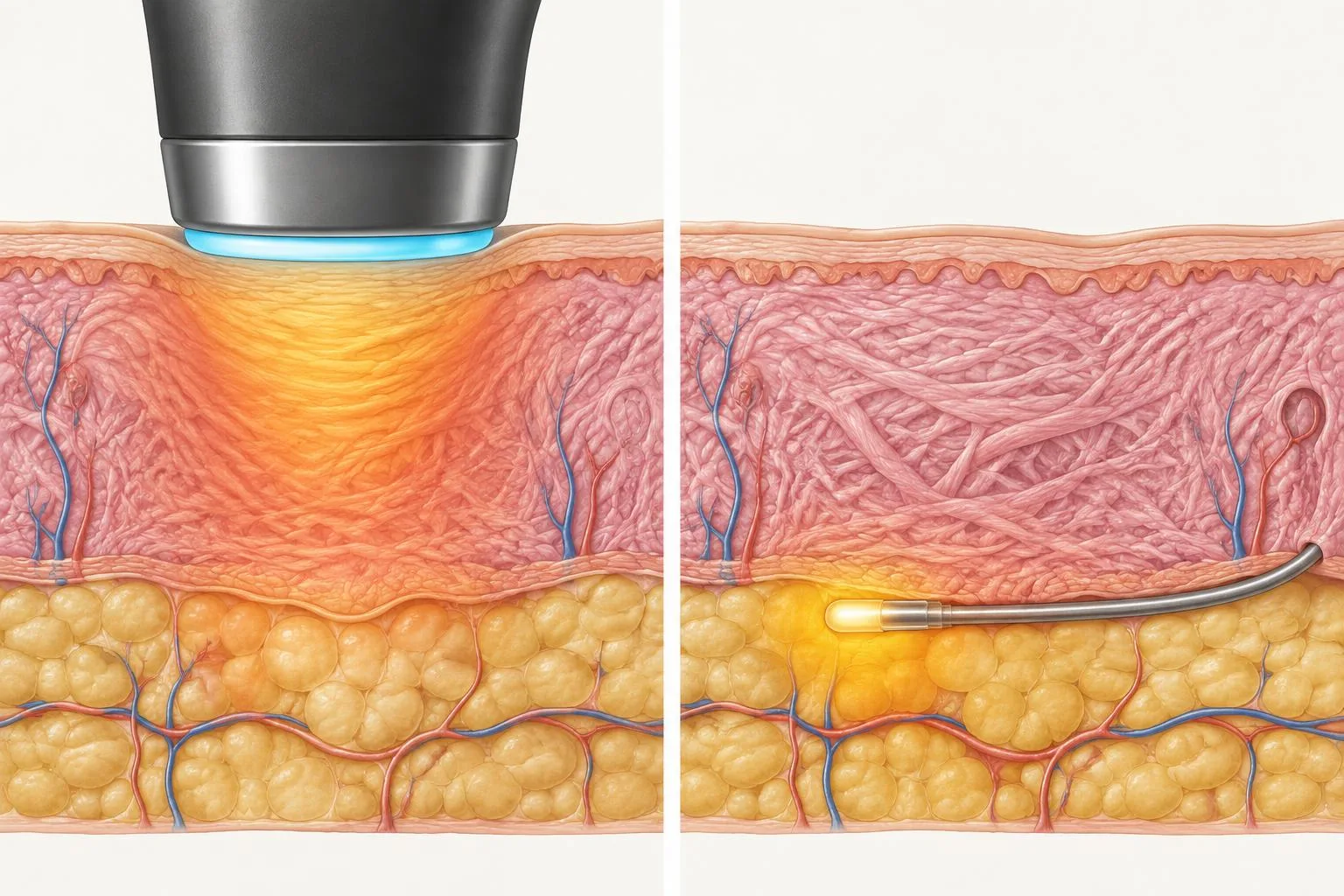
With XERF, the applicator stays on intact skin. No fibre or needle is introduced into tissue. Energy crosses the surface and produces a distribution of heating beneath it. ‘External delivery’ does not mean ‘only the epidermis is treated’: external RF can affect deeper tissue. The depth and temperature distribution are not a fixed distance that can be inferred from the brand name alone.
With a subdermal laser fibre procedure, the clinician introduces a fine optical fibre through a small entry point and guides it beneath the skin. Light is emitted locally within the selected tissue plane. This changes access, control and risk: it is a minimally invasive procedure, not an external facial. Local anaesthesia, anatomical knowledge, appropriate sterile technique and a complication-management plan matter.
Endolift is a trademarked Eufoton treatment associated with a 1470 nm laser platform. Cosmedocs uses a different dual-wavelength 980/1470 nm Endolaser platform. We do not perform the branded Endolift procedure. A shared subdermal principle does not establish identical performance, certification, dosing or outcomes, and Endolift studies cannot simply be relabelled as studies of our device.
The honest contrast is external electrical heating versus internally delivered laser light. It is not ‘beauty’ versus ‘real medicine’, nor proof that entering the skin automatically produces a better result. More direct access can offer a different intervention, while creating additional responsibilities and risks. [1–4]
| Treatment | Energy | Access | Delivery distinction |
|---|---|---|---|
| XERF | Monopolar RF: 6.78 + 2 MHz | Applicator on intact skin | Distributed heating; no inserted fibre |
| Endolift | 1470 nm laser | Optical fibre beneath skin | Local photothermal delivery in selected plane |
| Cosmedocs Endolaser | 980/1470 nm laser platform | Optical fibre beneath skin | Different device; not branded Endolift |
| Thermage | Monopolar RF | Applicator on intact skin | External electrical heating with cooling |
| RF microneedling | RF via needle electrodes | Needles enter skin | Delivery at device-selected needle depths |
| HIFU / microfocused ultrasound | Focused acoustic energy | Transducer on intact skin | Focal heating at selected depths |
What do the statistics actually show?
A 2026 peer-reviewed retrospective XERF study included 16 adult women, with a median age of 54.5 years. Each received one treatment and was assessed at one and three months. Measures included 3D photography, skin-quality analysis and FACE-Q questionnaires. Improvements in facial distribution, several skin-quality measures and patient-reported outcomes were reported; pigmentation did not significantly improve. There was no untreated or alternative-treatment control group. [2]
The mean procedural pain score was 4.31 ± 1.71 on a visual analogue scale. The authors reported severe pain in 12% of this small cohort. Three patients had transient redness, with swelling in one; no thermal injury or fat atrophy was observed. Those are findings from 16 people followed for three months, not proof of zero risk or universal comfort. The lack of numbing in a protocol does not mean the absence of pain.
The paper states that no external study funding was received, but Cynosure Lutronic performed the statistical analyses and supported the ethics submission. One author declared an international trainer relationship with the manufacturer. These disclosures do not invalidate the results; they belong beside them. The authors themselves call the findings preliminary and ask for larger controlled studies.
A 2024 XERF histology letter examined a porcine model. It reported changes in collagen bundles and deeper connective tissue after treatment. Its authors were affiliated with Lutronic. Animal tissue findings help investigate mechanism; they are not a percentage improvement in human jowls, a surgical-equivalence claim or a head-to-head trial. [3]
For Endolift, a 2024 systematic review included 23 studies across differing dermatological and cosmetic applications. It reported favourable findings, but small studies, heterogeneous indications and methods limit the strength of conclusions. A review spanning several conditions does not mean 23 robust trials specifically proving jawline lifting. Nor does it validate every generic fibre-laser device. [4]
We did not identify a peer-reviewed direct XERF-versus-Endolift or XERF-versus-Cosmedocs-Endolaser trial in this review. There is therefore no defensible percentage by which one is ‘better’. Separate studies use different populations, photography, rating scales and follow-up; comparing their improvement percentages as if they were one experiment is misleading.
Thermage, RF microneedling, HIFU, threads and surgery
Thermage is an established external monopolar RF platform. It shares XERF's broad energy family, not necessarily its pulse design or treatment protocol. A longer clinical history is useful context, but does not make every newer device ineffective or establish that two RF platforms are interchangeable.
RF microneedling is different again. Needle electrodes enter the skin and deliver RF within tissue. Needle depth, insulation and settings vary by device. It may be considered for texture, scars and selected laxity concerns, but it is not a needle-free XERF treatment and should not be described as working only above the skin. Thermal injury and unwanted tissue effects remain possible.
HIFU and microfocused ultrasound deliver acoustic energy through intact skin, concentrating it at selected depths. Some cartridges are designed for deeper targets than the dermis. External contact therefore does not imply shallow action. The systematic-review literature supports selected tightening outcomes but shows variation in assessment and response; it does not establish equivalence to surgery or a winner over fibre laser. [5]
Cog threads physically engage and reposition tissue; smooth mono threads do not provide the same mechanical lift. Filler replaces selected support or volume rather than removing excess skin. A surgical face or neck lift can reposition tissue and address skin excess in a way energy treatments cannot. If the problem is substantial descent or excess skin, changing the machine name does not remove the need to discuss surgery.
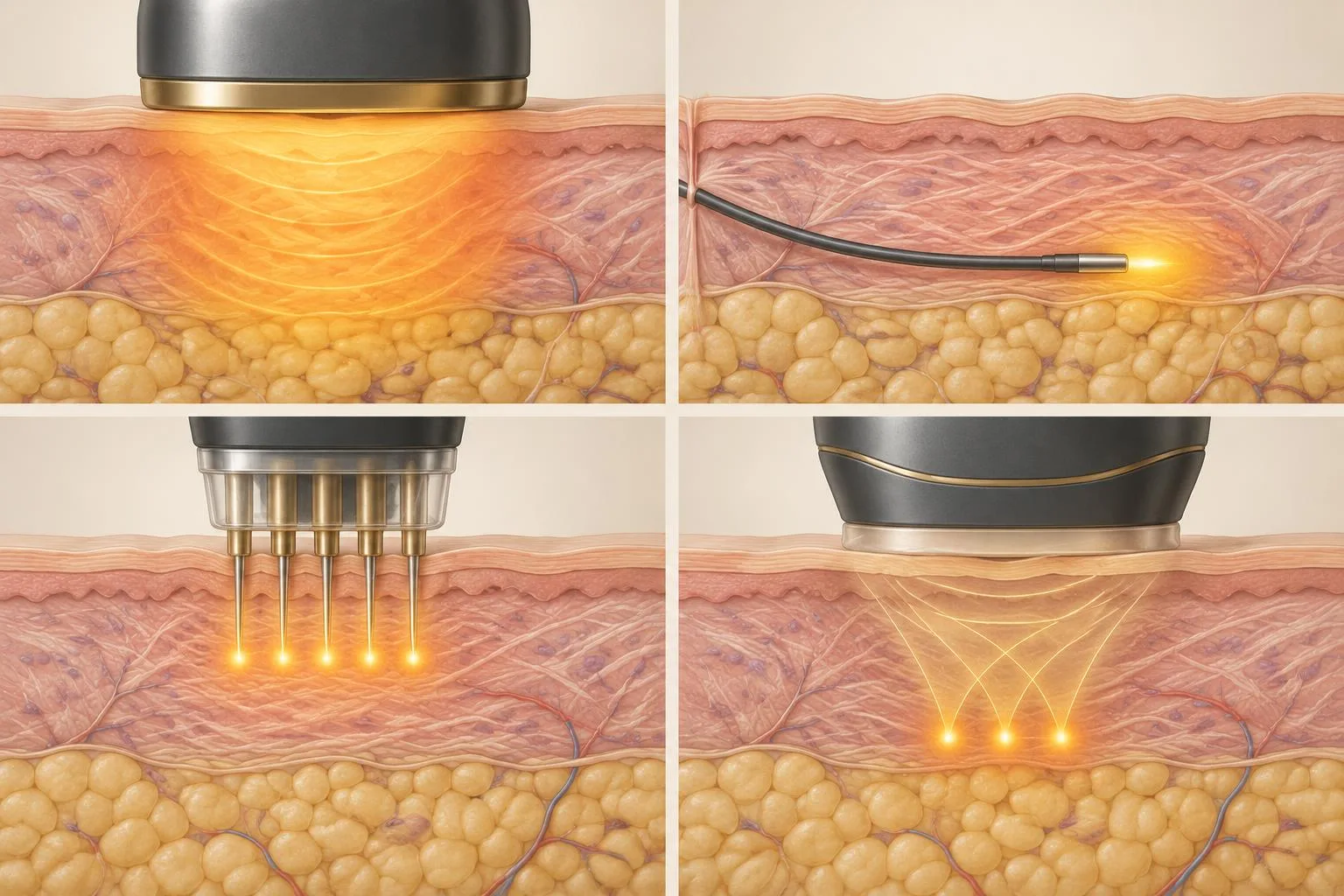
- Top left — external RF. A handpiece stays on the surface.
- Top right — fibre laser. The light source enters tissue.
- Bottom left — RF microneedling. Electrodes penetrate skin.
- Bottom right — focused ultrasound. Acoustic energy converges below the surface.
Who can perform XERF: a doctor or a therapist?
A reliable answer needs a country, a particular device and its instructions for use. There is no verified single worldwide minimum qualification for XERF. A manufacturer-trained therapist providing external RF in one jurisdiction does not establish the legal position elsewhere. In the UK, requirements may depend on the activity, local licensing, manufacturer instructions, insurance and professional scope. Ask the provider to demonstrate the rules that apply to their actual service, rather than accepting a blanket claim from a blog.
Likewise, a manufacturer certificate and a professional registration are different things. A doctor title is not device training; a training certificate is not a medical licence. For an invasive fibre-laser procedure, ask specifically about anatomical competence, local anaesthetic management, laser safety, sterile technique, escalation and aftercare. At Cosmedocs, Endolaser is doctor-delivered, with relevant CQC-required treatments provided in association with PrivaDr Ltd.
Operator eligibility tells you about governance and competence, not the measured power of a treatment. A therapist-operated device can still cause a significant thermal injury. Conversely, a doctor may appropriately choose a very conservative treatment. The meaningful questions are who assesses suitability, who performs it, what training they hold and who takes responsibility if something goes wrong. We have not verified a universal UK ‘doctor-only’ restriction for XERF and will not invent one.
XERF vs Endolift: which is better for jowls?
First establish what makes the jawline look different: skin quality, tissue descent, a local fat pocket, lost structural support or a combination. A photograph of a jowl cannot answer all those questions. Treating the wrong cause more intensely is still treating the wrong cause.
Someone prioritising intact-skin treatment and limited interruption may discuss external RF, including XERF, with an appropriately trained provider. Someone with suitable local laxity and fat distribution may discuss subdermal fibre laser with a clinician, accepting entry points, anaesthesia and a recovery period. Neither is automatically suitable for a thin, volume-depleted face. Fat reduction is not a universal anti-ageing benefit.
Ask for the expected change in your particular area, the evidence for that claim, realistic recovery, alternatives, contraindications and the plan if you are dissatisfied. Discuss implanted electronic devices and other implants, previous filler or threads, medical conditions and medication before any energy treatment. Contraindications and sequencing must be checked against the specific device and your medical history.
Our position is assessment before intervention. XERF is a non-invasive aesthetic RF treatment with identifiable technical refinements and preliminary clinical evidence. Endolaser is a different, minimally invasive laser approach. We favour choosing by anatomy and priorities, not making a competing treatment look trivial. Sometimes the most useful plan is to leave an area alone.
Frequently asked questions
Is XERF radiofrequency or laser?
XERF is external, non-invasive monopolar radiofrequency, using sequential 6.78 MHz and 2 MHz delivery. It is not a laser and does not insert a fibre beneath the skin.
Does XERF only treat the skin surface?
No. The applicator stays on the surface, but RF heating can extend into underlying tissue. External delivery and superficial biological effect are not the same thing; depth depends on the device, settings and tissue.
Is XERF better than Endolift?
No direct peer-reviewed comparative trial was identified in this review. XERF delivers external RF; Endolift delivers subdermal laser light. The more suitable approach depends on the problem, patient priorities, risks and practitioner assessment, not a universal ranking.
Is Endolaser the same as Endolift?
No. Endolift is a trademarked Eufoton treatment. Cosmedocs uses a different dual-wavelength 980/1470 nm Endolaser platform. Both involve subdermal fibre delivery, but brand-specific evidence and results must not be assumed interchangeable.
Can a therapist perform XERF in the UK?
A single universal UK minimum qualification for XERF was not verified in this review. Check the specific manufacturer's instructions, provider training, applicable local requirements, insurance and clinical oversight. A job title alone establishes neither competence nor treatment power.
Does no numbing mean XERF is painless?
No. In a 2026 retrospective study of 16 women, mean procedural pain was 4.31 ± 1.71 on a visual analogue scale, with severe pain reported in 12%. This small study does not predict every patient's experience.
Sources and limits
Sources checked 11 October 2026. Manufacturer information establishes device specifications; it does not establish comparative efficacy. This is a targeted narrative review, not an exhaustive systematic review. No medical reviewer sign-off is claimed for this newly prepared editorial.
- [1] Cynosure Lutronic. XERF manufacturer technology and treatment information. cynosure.com/xerf/. Accessed 11 October 2026. Manufacturer claims are not independent comparative evidence.
- [2] Erlich G, Dahan E, Wolf Y. Objective and subjective retrospective evaluation of XERF, a novel single-shot dual-frequency non-invasive monopolar radiofrequency. Lasers in Medical Science. 2026;41:194. DOI: 10.1007/s10103-026-04996-0. Published 18 August 2026. Sixteen women, retrospective, no control, three-month follow-up; manufacturer statistical support and trainer relationship disclosed.
- [3] Hong J and colleagues. Efficacy of dual-frequency noninvasive monopolar radiofrequency in skin tightening: Histological evidence. Skin Research and Technology. 2024. PMCID: PMC11180671. Porcine-model histology letter; Lutronic-affiliated authors. Not a human comparative outcomes trial.
- [4] Nilforoushzadeh MA and colleagues. The Endo-lift Laser (Intralesional 1470 nm Diode Laser) for Dermatological Aesthetic Conditions: A Systematic Review. Aesthetic Plastic Surgery. Published 17 June 2024. DOI: 10.1007/s00266-024-04082-2. Twenty-three included studies spanning multiple indications; evidence levels III and IV, not evidence for every generic laser platform.
- [5] Contini and colleagues. A systematic review of the efficacy of microfocused ultrasound for facial skin tightening. International Journal of Environmental Research and Public Health. 2023. Device- and outcome-specific evidence; not a XERF-versus-laser comparison.
Continue reading
- Cosmedocs Endolaser: assessment, procedure and area-specific fees
- Endolift explained: understanding the branded treatment
- Facial fat loss: when reduction helps and when it does not
- Understanding the causes of jowls
- Bring the concern, not a predetermined treatment
We work with PrivaDr Ltd, 10 Harley Street, London W1G 9PF for all CQC required treatments.