
Clinical Editorial — Bruxism & Aesthetic Medicine
Tooth Chipping, Night Grinding & The Masseter Muscle
Why your front teeth chip, your molars flatten and your jaw aches at sunrise — the hidden mechanics behind clenching, the forces an enlarged masseter generates, and how a dentist's mouthguard combined with masseter Botox quietly protects your smile.
Most patients arrive in our clinic believing the chipped corner of a front tooth is bad luck — a hard olive stone, a careless bite on cutlery, a fall as a child. In reality, the overwhelming majority of chipped, flattened or hairline-cracked teeth in adults are caused by something far quieter and far more persistent: nocturnal bruxism. Grinding and clenching while you sleep, often unnoticed for years, can destroy enamel that is otherwise designed to last a lifetime. The culprit is rarely the teeth themselves. It is the muscle behind them — the masseter.
A muscle the size of a thumb, the force of a vice
The masseter is one of the strongest muscles in the human body relative to its size. It runs from the cheekbone to the angle of the jaw and is responsible for closing the mouth against resistance. In normal chewing — a slice of bread, a piece of fish, a soft apple — it generates roughly 70 to 150 Newtons of bite force per side. That is more than enough to break down food without ever threatening the integrity of your teeth.
Bruxism changes the equation entirely. During sleep clenching, the cortex sends a sustained, unmodulated signal to the masseter and temporalis. Force studies in chronic grinders have recorded peaks of 600 to 1,100 Newtons — five to ten times the load of normal chewing — sustained for minutes at a time, multiple cycles per night. This is the force of a small vice gripping your teeth against each other, hour after hour, year after year.
Now consider that the average human enamel can absorb cyclical loads of around 200–300 Newtons before microfracture begins. The maths is brutal: every night, a hypertrophied masseter is delivering forces well beyond the design tolerance of the very teeth it is meant to support.
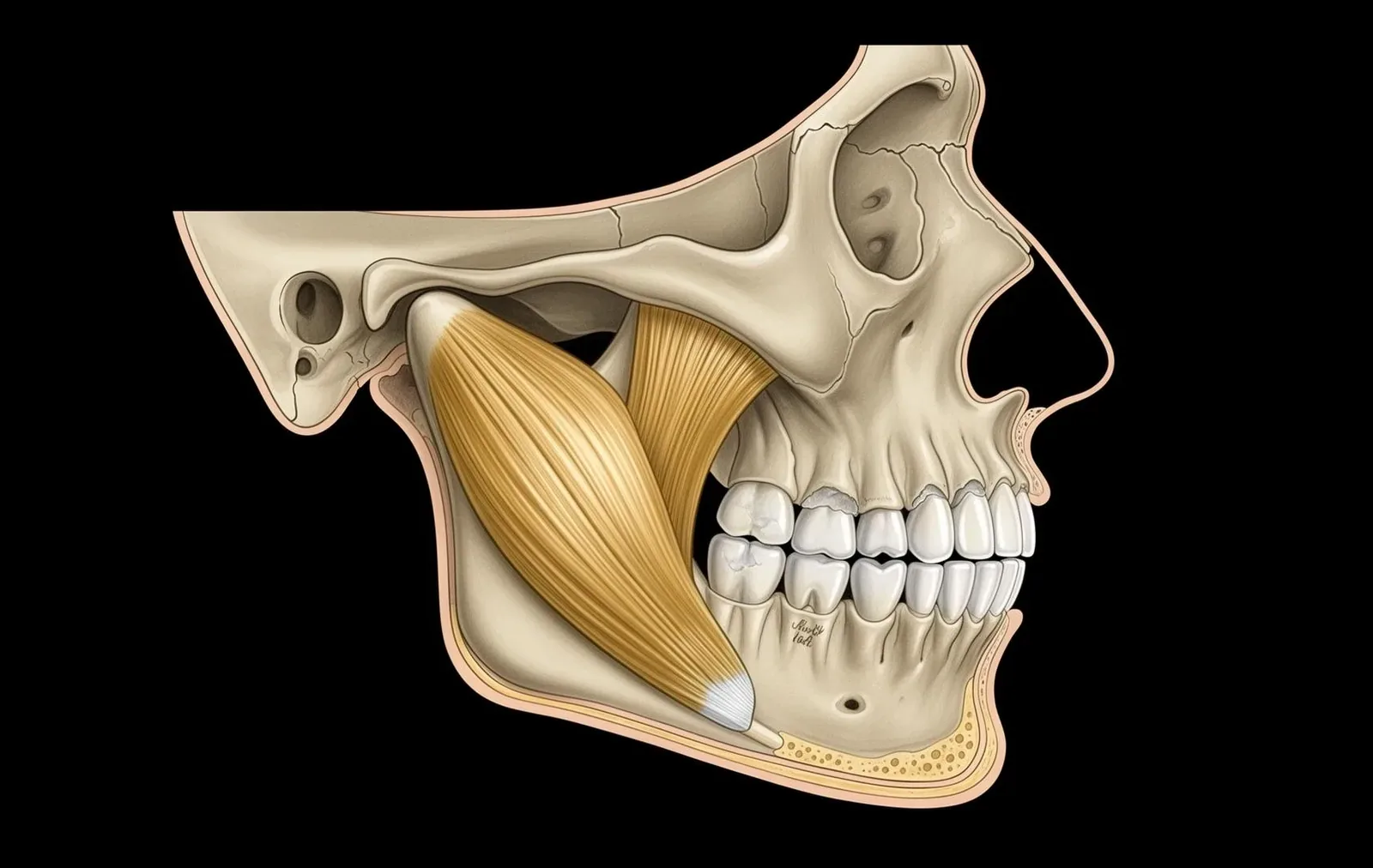
Normal masseter vs. enlarged masseter — the force gap
A normal-volume masseter behaves like a finely tuned engine. It contracts when food enters the mouth, relaxes between bites and never recruits its maximum fibres unless absolutely necessary. The result is efficient mastication and almost no wear on the teeth.
An enlarged or hypertrophied masseter — the kind we see in chronic grinders, gym athletes who chew gum constantly, stress-clenchers and patients with deep bites — behaves very differently. It is essentially over-muscled for the job. Like any over-built muscle it tends to contract harder than required, fires more readily during sleep arousals, and loses the subtlety of low-force activation.
On the inside of the cheek you can often see the visible signature: a white horizontal ridge called linea alba, where the soft tissue has been habitually pressed between clenched molars. On the outside, the lower face squares off into the masculine, heavy "boxed" jawline that so many patients ask us to soften.
In numbers
- Normal bite force: 70–150 N per side (chewing)
- Enlarged masseter clench: 600–1,100 N per side
- Enamel microfracture threshold: ~200–300 N cyclical
- Average clench duration in sleep bruxism: 5–8 seconds, 25+ episodes per night
How a tooth is actually built — and why the front goes first
A tooth is a layered structure. The outer shell is enamel, the hardest substance in the human body — roughly the hardness of mild steel. Beneath that sits dentine, a softer, slightly elastic layer that absorbs shock. At the core lies the pulp, with nerves and blood supply.
Enamel is brilliant at resisting vertical compression. Its prismatic crystals are oriented to shrug off the load of biting straight down through food. What enamel handles very poorly is lateral shear — side-to-side rubbing — and cyclical micro-impacts, which is precisely what grinding delivers.
Front incisors are anatomically thin. Their job is to slice, not crush. They have a delicate incisal edge, a feathered enamel margin and almost no mechanical reinforcement at the corners. When the lower jaw slides forwards or sideways during a grinding episode, the upper and lower incisors are the leading edges that meet first. They take the friction. They take the impact. And they are the first to chip.
Molars, with their broad cusps, fail differently. Instead of breaking off, they slowly flatten. The pointed mountains of healthy molar anatomy erode into smooth, table-top surfaces — the classic radiographic and intra-oral sign every dentist recognises as advanced bruxism.
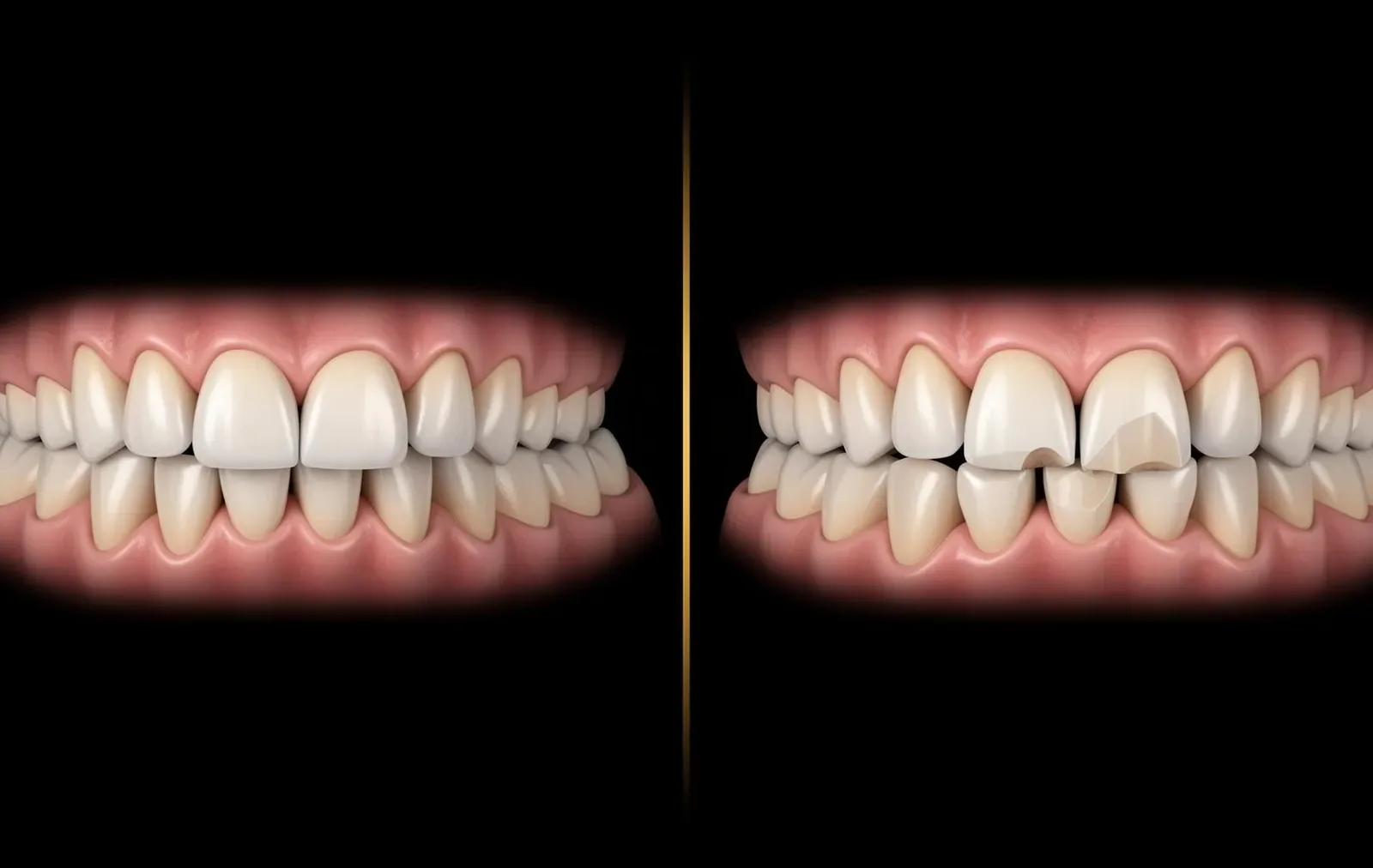
When clenching meets grinding — the worst combination
Clinically we separate two patterns. Clenching is static — the jaw locks and the muscles hold a tonic contraction. It is silent, often happens during the day at the desk, and leads to muscle fatigue, jaw ache, temporal headaches and a feeling of "tight ears." Grinding is dynamic — a rhythmic side-to-side sawing motion, almost always at night, audible to a sleeping partner.
The most damaging patients are those who do both: they clench down to maximum force and then drag the jaw across, scraping their incisors edge-to-edge under enormous load. This is the mechanism that chips a front tooth in a single night and explains why a patient can wake up with a piece of enamel on the pillow having done absolutely nothing unusual the day before.
The dentist's first line — a properly fitted mouthguard
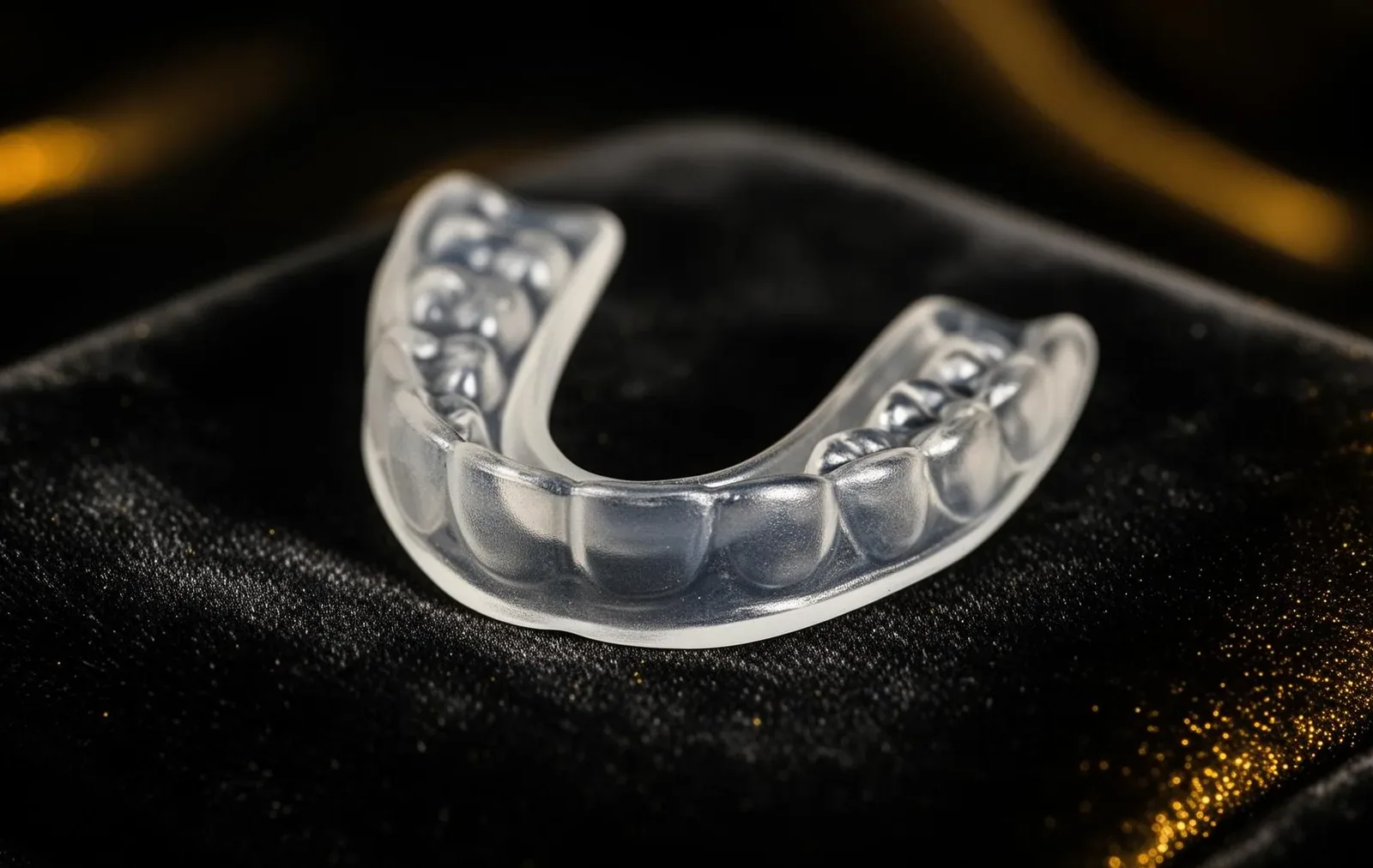
A custom occlusal splint, made from an impression of your own teeth, remains the foundation of bruxism care. We always recommend patients see their dentist for a hard acrylic night guard before — and alongside — any aesthetic intervention. The splint does three things well:
- It places a sacrificial layer of acrylic between upper and lower teeth, so the splint wears down instead of your enamel.
- It evenly distributes the bite, preventing single-tooth point loading on the front incisors.
- It deprogrammes the muscles slightly, often reducing morning jaw stiffness within a fortnight.
What a mouthguard cannot do is reduce the muscle force that is driving the problem. The masseter still fires at 800 Newtons. The TMJ still receives the load. The headaches and muscle ache persist. The lower face continues to widen as the muscle hypertrophies. This is where medical aesthetic treatment enters the conversation.
Masseter Botox — turning the volume down on the muscle
Masseter Botox works at source. A precise dose of botulinum toxin — typically 25 to 50 units per side, depending on muscle bulk — partially blocks the nerve signal that tells the masseter to contract maximally. The muscle does not stop working; it can no longer fire at destructive intensities. Within two to four weeks, patients describe the same sensation almost word-for-word: "my jaw feels softer."
Three things follow from that single change:
- Tooth protection. Bite forces drop back towards the physiological 100–200 N range. Enamel and existing dental work — veneers, crowns, composite bonding — stop being chronically overloaded. Future chipping risk falls dramatically.
- Symptom relief. Morning jaw ache, temporal headaches, ear fullness and TMJ clicking improve in a majority of patients within the first month.
- Aesthetic refinement. Because the muscle is no longer hypertrophying, the lower face slims and softens over three to six months. The squared boxed jawline returns to a more oval, feminine — or more refined masculine — contour. This is the cosmetic side effect patients quietly love.
The combined protocol we recommend at Cosmedocs
For any patient presenting with chipped front teeth, flattened molars, morning jaw ache or a partner reporting audible night grinding, our protocol is:
- Dental review. See your dentist for an occlusal assessment and a hard acrylic splint. Address any acute fractures with bonding, onlay or veneer where indicated.
- Masseter Botox. A clinical assessment with our doctors, followed by precise dosing into the safe lower-third of each masseter. Two to three sessions across six to nine months are usually enough to retrain the muscle.
- Stress and sleep hygiene. Bruxism is closely linked to sympathetic arousal. Caffeine timing, alcohol moderation and basic sleep architecture matter more than most patients realise.
- Annual review. Re-photograph the dentition, re-measure the masseter, and adjust dose downwards as the muscle de-hypertrophies. Many patients eventually maintain results with a single yearly top-up.
Normal masseter
70–150 N during chewing. Subtle activation. No measurable wear on enamel over decades.
Hypertrophied masseter
600–1,100 N during nocturnal clench. Forces well beyond enamel design. Visible chipping within months.
Why this matters beyond the smile
A chipped front tooth is the most visible consequence of bruxism, but it is rarely the only one. Patients with untreated grinding go on to develop temporomandibular joint dysfunction, chronic tension headaches, accelerated periodontal recession at the gum line and — in cosmetic terms — the progressive squaring of the lower face that reads as "tired" or "heavier" at every birthday.
Treating the masseter is therefore not a vanity decision. It is preventive dentistry, preventive neurology and preventive aesthetics, delivered in a single ten-minute appointment. This is the kind of quiet, invisible intervention our clinic was built around — transformation that speaks without saying a word.
Protect your teeth at the source
If you are chipping, clenching or waking with jaw ache, a single consultation will tell you whether masseter Botox is the right next step for you.
Related reading
This article is educational and does not replace a clinical assessment. Bruxism is a multi-factorial condition and treatment decisions are made on an individual basis after consultation with a qualified doctor and your dentist.