Medically reviewed by Dr Hena Haq, Aesthetic Physician, Cosmedocs Harley StreetGMC 7223492Last reviewed
Salicylic Acid Peel
The only fat-soluble peel that penetrates deep into pores — dissolving sebum, clearing acne, and refining oily skin from within.
BHA (Beta Hydroxy Acid) · Lipophilic · Oil-Soluble Exfoliation
What Is a Salicylic Acid Peel?
Salicylic acid is a beta hydroxy acid (BHA) derived from willow bark — and it is the only BHA used in chemical peels. What makes salicylic acid fundamentally different from all other peeling agents is its lipophilicity — it is fat-soluble.
This fat solubility is clinically significant. While alpha hydroxy acids (AHAs) like glycolic and lactic acid are water-soluble and can only act on the skin surface, salicylic acid dissolves in the natural oils (sebum) that line your pores. This allows it to penetrate deep into the follicular unit — past the sebum plug, into the pore lining itself — where it dissolves the oil, keratin, and debris that cause blackheads, whiteheads, and inflammatory acne.
In pharmacological terms, salicylic acid is both keratolytic (breaks down keratin bonds between dead skin cells) and comedolytic (dissolves comedones — the plugs that block pores). It also possesses inherent anti-inflammatory properties, reducing redness and swelling associated with acne lesions. This combination of oil-soluble penetration, keratolysis, and anti-inflammation makes salicylic acid the gold standard peel for oily, acne-prone skin.
How Salicylic Acid Cleans Your Pores
A clinical diagram showing the three-stage process: clogged pore → BHA penetration and exfoliation → clear, refined pore.
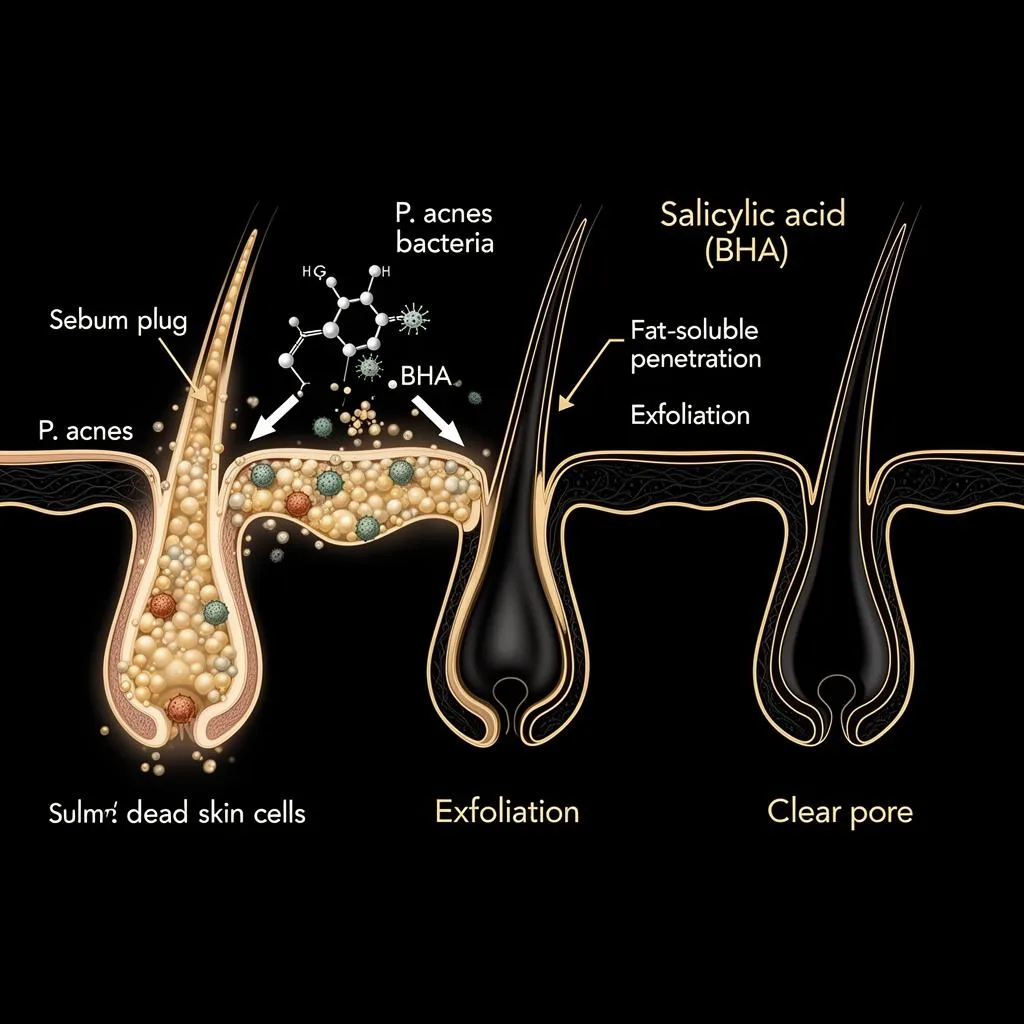
Clogged pore → Salicylic acid (BHA) fat-soluble penetration → Exfoliation & bacterial reduction → Clear pore
Fat Solubility — Why It Matters
The concept of lipophilicity is central to understanding why salicylic acid outperforms AHAs for certain skin concerns. Human sebum is a complex mixture of triglycerides, wax esters, squalene, and free fatty acids. It coats the inside of every pore and forms the "glue" that holds dead skin cells together within the follicular canal.
Water-soluble acids cannot pass through this lipid barrier. They are effective at the epidermal surface — loosening intercellular bonds and promoting superficial exfoliation — but they cannot reach the root cause of comedonal and inflammatory acne deep within the pore.
Salicylic acid, being fat-soluble, dissolves directly into the sebum. It travels down the pore, dispersing through the lipid-rich environment, breaking apart the keratin plugs and dissolving the sebaceous material that feeds P. acnes bacteria. This intra-follicular action is why dermatologists worldwide regard salicylic acid as the first-line chemical peel for acne vulgaris.
At Cosmedocs, we use pharmaceutical-grade salicylic acid at concentrations between 10–30%, calibrated to your skin's sensitivity, Fitzpatrick type, and acne severity. The peel is self-neutralising — meaning it stops working once it has penetrated to its target depth — adding an inherent safety mechanism.
Supporting Ingredients
We enhance every salicylic acid peel with clinically proven active ingredients to amplify results and protect your skin.
Mandelic Acid
A larger-molecule AHA derived from almonds. Its slower penetration makes it gentler and particularly suitable for darker skin tones (Fitzpatrick IV–VI). Combined with salicylic acid, it provides dual-action exfoliation — surface and intra-pore.
Azelaic Acid
A dicarboxylic acid with anti-inflammatory, anti-bacterial, and anti-melanogenic properties. It targets post-inflammatory hyperpigmentation (the dark marks left by acne) and inhibits tyrosinase to prevent further pigment production.
Tea Tree Oil
A natural antimicrobial that complements salicylic acid's antibacterial action. Studies show tea tree oil reduces acne lesion count comparably to benzoyl peroxide but with fewer side effects.
Pyruvic Acid
A keto acid that converts to lactic acid on the skin. Offers enhanced penetration and sebum-regulating properties, making it an excellent adjunct for oily, acne-prone skin.
Retinol (Pre-Treatment)
Used in pre-peel protocols to accelerate cell turnover and thin the stratum corneum, allowing the salicylic acid to penetrate more evenly and effectively.
Antioxidants (Glutathione, Vitamin C)
Applied post-peel to neutralise free radicals generated during the exfoliation process, reduce inflammation, and protect newly revealed skin from oxidative damage.
Am I Suitable?
Ideal For
- • Active acne (comedonal and inflammatory)
- • Oily, sebum-overproducing skin
- • Blackheads, whiteheads, and congestion
- • Enlarged pores
- • Post-acne hyperpigmentation
- • Rosacea (at lower concentrations)
May Not Be Suitable
- • Aspirin/salicylate allergy
- • Pregnancy or breastfeeding
- • Active eczema or dermatitis on treatment area
- • Recent isotretinoin use (within 6 months)
- • Open wounds or active infections
- • Recent sunburn or laser treatment
Frequently Asked Questions
Other Peel Types
Peel to Reveal — our signature cocktail peel — from £150
At a Glance
Duration
20–45 minutes
Course
3–6 sessions
Recovery
1–7 days peeling
Types
Light, medium, deep
Treatment Pricing
Includes skin assessment
Natasha W.
"After three chemical peels my pigmentation has faded dramatically. My skin is the clearest it's been in years. Worth every session."
More real experiencesSalicylic Acid Peel London — Clinical Guide
Salicylic acid (2-hydroxybenzoic acid) is classified as a beta hydroxy acid with the molecular formula C₇H₆O₃. Its lipophilic character — the ability to dissolve in lipids rather than water — is what distinguishes it from every alpha hydroxy acid used in dermatology. This fat solubility allows salicylic acid to partition into the sebaceous lipid environment within the pilosebaceous unit, reaching the site of comedone formation and bacterial colonisation.
Clinical studies have demonstrated that salicylic acid peels at 20–30% concentration significantly reduce acne lesion counts, sebum production, and pore diameter within 4–6 sessions. The acid's inherent anti-inflammatory mechanism — inhibition of prostaglandin synthesis via cyclooxygenase pathway modulation — reduces erythema and swelling without systemic effects.
At Cosmedocs Harley Street, salicylic acid peels are enhanced with supporting active ingredients including mandelic acid for gentle dual-acid exfoliation, azelaic acid for its melanogenesis-inhibiting properties, pyruvic acid for enhanced keratolysis, and post-peel antioxidant cocktails (glutathione, ascorbic acid) for oxidative protection. Our clinicians assess each patient's Fitzpatrick skin type, acne grade (Leeds classification), and sebum production before selecting the optimal concentration and supporting agent combination.
The Peel to Reveal cocktail integrates salicylic acid into a multi-acid fusion alongside glycolic, lactic, and TCA acids — creating a customisable treatment that addresses acne alongside pigmentation, texture, and ageing concerns simultaneously. Our aesthetics is invisible art — bold, natural, always your way.